Behind the Scenes: How Your Website Actually Gets Built
“Do you just… start designing right away?”
That’s a question we hear a lot.
Most people think a website starts with colors, images, and layout.
But the truth is—it doesn’t.
For many businesses in Albany and the surrounding areas, a strong website starts with a plan.
Because a good website isn’t just about looking nice.
It’s built step-by-step to do something important:
- Help people find you
- Build trust quickly
- Turn visitors into leads
How Is a Typical Website Actually Gets Built?
Here’s just a snapshot of what that process looks like:
Step 1. Planning & Wireframing (The Blueprint)
Before anything is designed, we map everything out.
This step is called wireframing.
Here’s a simple example of what that looks like:
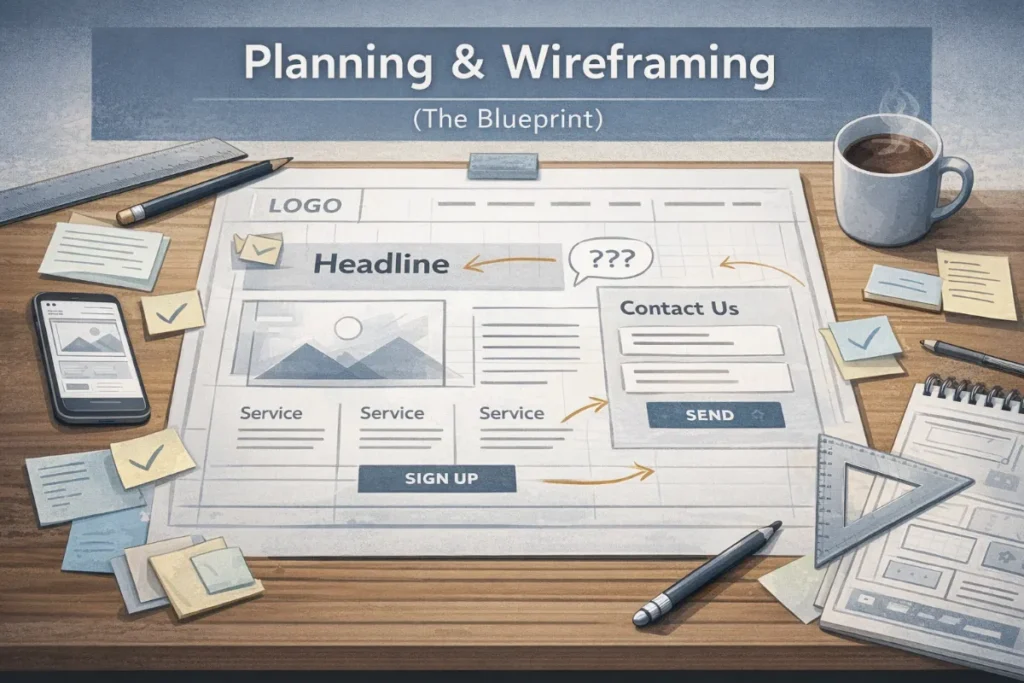
At this stage, we focus on structure—not colors.
We plan:
- Where your headline goes
- How your services are shown
- Where buttons and contact forms should be placed
Why this matters:
A website should guide people, not confuse them.
Wireframing helps create a clear path so visitors know exactly what to do next.
Step 2. Content & Structure
Next, we focus on what your website says.
This includes:
- Your message
- Your services
- How your pages are organized
We make sure your site answers key questions:
- What do you do?
- Who do you help?
- How can someone contact you?
Clear content makes your website easier to understand—and easier to trust.
Step 3. Design (Bringing It to Life)
Now the visual part begins.
This is where we add:
- Colors
- Fonts
- Images
- Layout styling
The goal is simple:
Make your business look professional and easy to trust
But design is not just about looks—it supports the structure we already planned.
Step 4. Development (Building the Site)
Now we build your website.
Many sites today are built using WordPress.
We often use the Kadence framework to create fast, flexible websites.
This step includes:
- Building each page
- Setting up navigation
- Making sure everything works smoothly
Step 5. Optimization (Speed, Mobile, SEO)
Before launch, we fine-tune everything.
This includes:
- Making sure your site loads quickly
- Ensuring it works well on phones and tablets
- Setting up basic SEO so people can find you
A slow or confusing website can lose visitors fast.
This step helps prevent that.
Step 6. Launch & Testing
Once everything is ready, we go live.
But before that, we test:
- Links
- Forms
- Mobile layout
- Overall performance
This helps make sure everything works the way it should.
Step 7. Ongoing Improvements
A website is not a one-time project.
Over time, you may need to:
- Update content
- Add new services
- Improve performance
Your website should grow with your business.
What This Means for Your Business
A website isn’t just designed—it’s built with purpose.
Each step plays a role in helping your business:
- Get found
- Build trust
- Turn visitors into customers
The Bottom Line
A strong website doesn’t happen by accident.
It starts with a plan, follows a clear process, and continues to improve over time.
If your current website feels random or isn’t bringing results, it may be missing that structure.
Want to know what’s included when working with a website designer? Check out: What Services Do Website Designers Provide?
Thinking About a New Website or Redesign an Existing One?
If you’re planning a new website—or wondering why your current one isn’t performing—it helps to have a clear process.
We build websites with structure, speed, and real business goals in mind.
If you’d like to talk through your project, feel free to reach out.