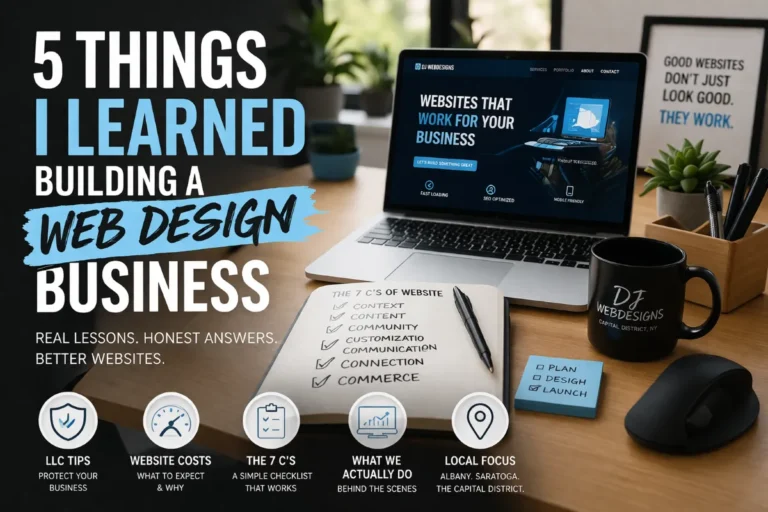

How to Build a Profitable Web & Graphic Design Business
How did you build a profitable web design agency?
The landscape is now even more complex. Artificial intelligence, AI-powered search, voice search, and Google AI Overviews are changing the way businesses are discovered online. Clients are no longer using search engines; they are looking to ChatGPT, Gemini, Perplexity, and other AI tools to suggest search recommendations.
The good news? I am not surprised that the basic principles of building a profitable web design business still do exist.
What actually makes a web design business profitable?
Technology skills are a major focus for web designers:
- WordPress development.
- Graphic design.
- UX/UI design.
- SEO implementation.
- Website performance.
These skills are important, but they do not produce revenue. The best web designers know how to:
- Create qualified leads.
- Build trust and authority.
- Price services confidently.
- Manage client relationships.
- Create repeatable systems.
- Create recurring revenue streams.
- Provide measurable business results.
In other words, they work like business owners—not just designers.
The biggest lesson I learned
The best lesson I learned is that growth happens when you stop thinking like a freelancer and begin thinking like a business owner. I spent so much time honing my design skills and not the business basics for so many years. And the more I focused on building systems and processes, the easier it was for me to onboard clients:
- Proposals became more professional.
- Projects became more predictable.
- Marketing became more consistent.
- Revenue was more stable.
The difference was not better design. The difference was better business.
Skills Every Modern Web Designer Needs in 2026
Today’s web designers need more and more skill sets than ever.
Search Engine Optimization (SEO)
SEO remains important because companies still want their business to be in the search pages. But now SEO includes:
- Traditional search rankings.
- Local SEO.
- Featured snippets.
- Google AI Overviews.
- Structured data.
- Entity optimization.
Read more about Search Engine Optimization
Generative Engine Optimization (GEO)
Generative Engine Optimization is the process of helping AI platforms understand and recommend your business. To improve GEO:
- Write helpful content.
- Demonstrate expertise.
- Create topical authority.
- Use clear site structure.
- Include FAQs and schema markup.
Read more about: Generativve Engine Optimozation
Answer Engine Optimization (AEO)
Answer engines reward websites that provide direct and useful answers. An effective AEO has the following sections:
- Question-based headings.
- FAQ sections.
- Clear explanations.
- Concise answers.
- Structured content.
Read more about Answer Engine Optimization
Relationship Building
AI can help generate content. But it cannot replace real relationships. Some of my best projects have been from:
- Referrals.
- Networking groups.
- Past clients.
- Strategic partnerships.
- Community engagement.
Relationships are one of the most powerful marketing tools.
Systems Create Freedom
The most important lesson I learned at the beginning of my career was to have repeatable systems. Without systems, every project seems different. Systems make life more efficient and scalable.
An example of this is: lead management
We need to have the same process for:
- Inquiry forms.
- Discovery calls.
- Follow-up emails.
- Proposal delivery.
Client Onboarding
Develop a common onboarding experience that includes:
- Welcome documents.
- Project timelines.
- Content requirements.
- Communication expectations.
Read more about The 6-Step Web Design Process for Small Businesses
Project Delivery
Workflows are documented for:
- Website planning.
- Design reviews.
- Development.
- Testing.
- Launch.
The more repeatable your processes are, the more profitable your business will be.
Why Recurring Revenue is Important
One of the most common mistakes web designers make is to rely solely on projects for income. Projects end. Recurring revenue continues.
Some examples:
- Website maintenance plans.
- Hosting management.
- Local SEO services.
- Website updates.
- Security monitoring.
- Content updates.
Recurring revenue brings stability and allows you to keep focused on long-term growth and not just on the next project.
What I Would Do Differently Today
In today’s AI-infused setting, I would start on five things right now:
- Build a niche-based website.
- Write content that answers customer questions.
- Get a very strong local SEO presence.
- Have a consistent network.
- Establish recurring revenue services from day one.
These five strategies would likely produce results much faster than spending months perfecting a portfolio.
The future of web design businesses
As I worry about how AI will replace web designers, I believe there will be a huge demand for experienced professionals. Businesses still need experts who can:
- Establish trustworthy websites.
- Improve user experience.
- Generate leads.
- Optimize for search and AI discovery.
- Create conversion-based content.
- Maintain and secure websites.
AI can accelerate the work. It can’t replace strategy, expertise, and human insight.
Read more about AI Can Build Your Website — But Can It Keep It Growing?
Final Thoughts
The development of a profitable web design business is not about finding a secret formula. It is about marrying great design with strong business fundamentals. Web designers who will thrive in the next decade will be those who embrace traditional marketing and AI-driven discovery channels. Work on systems, build authority, achieve results, and build long-term client relationships. When I started my business, those principles worked well and still work today.
If you’re looking for how to build an SEO, AEO, and GEO site that is designed for real business results, I’d be happy to help.