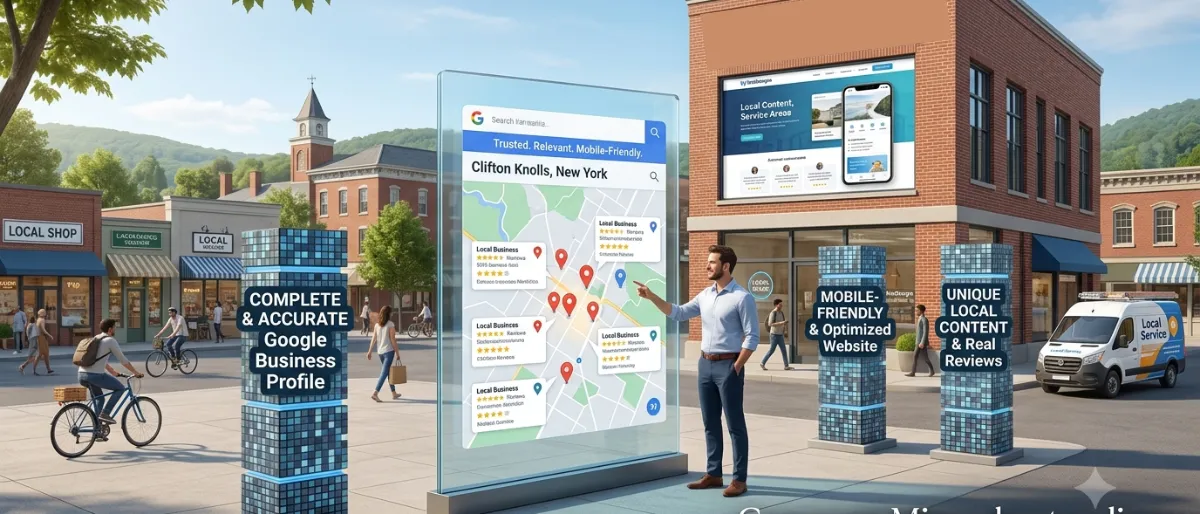
Local SEO Myths & Misconceptions
Common Misunderstandings About Website and Local SEO
As search engines and artificial intelligence become more sophisticated, misunderstandings about websites and Local SEO do too. Below are some myths that are problematic for businesses and hinder their online visibility.
The following misconceptions are among the most common advice business owners receive about websites and Local SEO. While they may sound reasonable, they often lead to missed opportunities or ineffective SEO strategies.
Google Business Profile Proximity vs. Service Area Radius
Misunderstanding #1: “Including every city I serve on my Google Business Profile will increase my ranking.”
Many service-area businesses think that listing many cities on their Google Business Profile (GBP) will automatically boost their rankings in those locations. However, this is not how Google’s local search algorithms work.
Google considers several factors in ranking: the relevance of the business, user context, visibility to users, customer approval, website quality, and overall online authority. Just adding more cities does not guarantee better visibility in those regions.
Optimizing Your Real Service Footprint
Instead, your Google Business Profile should accurately represent the areas you actually serve, and that is complemented by a well-optimized website. According to BrightLocal, Local SEO is all about building an online presence and not just expanding your list of service areas.
Your Google Business Profile has made you more likely to be found; however, your website also tells Google why your business deserves higher rankings.
The only piece of the puzzle is for you to understand Google Business Profile. Your website content also plays a major part in how it appears in local searches.
Dynamic Local Content vs. Duplicate Doorway Pages
Misunderstanding #2: “Producing numerous city pages ensures better rankings.”
Some businesses create multiple location pages by duplicating content but just changing the city name. This may seem to be a good SEO strategy for content, but it leads to very thin or repetitive content that is difficult for users to view.
What Makes a High-Value Location Page?
Each location page should provide information that is actually beneficial to the residents of the community. A good city page can include services that are tailored to that particular area, common needs of customers, notable landmarks or neighborhoods served, customer testimonials relevant to that locality, frequently asked questions, appropriate images or completed projects, and community engagement or collaborations.
Google is looking for original, useful content that has local relevance. We have learned that a single well-crafted location page is much more valuable than several generic pages.
Having unique location pages is another common misconception that you don’t need a website when you have a Google Business Profile.
Maximizing Digital Footprints: Why GMB/GBP Cannot Replace a Website
Misunderstanding #3: “If my Google Business Profile is high-ranking, I don’t need a website.”
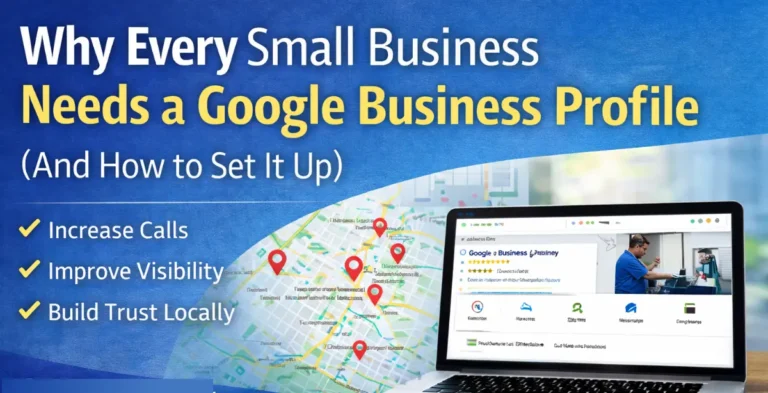
While a Google Business Profile is important for Local SEO, it is not a substitute for a professional website. Consider your GBP as an online storefront; your website is where visitors can learn about you—who you are, what services you provide, and why they should consider your business.
Converting Google Business Profiles Traffic into Leads
A well-designed website helps you: explain products or services you offer, build trust through testimonials and case studies, get leads via your contact form, support traditional SEO along with AEO and GEO strategies, and get visibility beyond just Google Maps.
Your Google Business Profile brings potential customers to your business; your website helps convert interested visitors into clients.
Great lessons learned: The best Local SEO strategy is to take an optimized Google Business Profile and marry it with a modern and successful website.
As you can see, many of these misconceptions are directly related to the website features discussed earlier in this guide. Features such as Local SEO, mobile-friendly design, schema markup, AEO, GEO, and lead generation work together to create a website that is easier for both people and search engines to understand.
Core Pillars of a Successful Local SEO Strategy
Expert Recommendations
So, what do industry experts recommend? BrightLocal and industry experts have always stressed that Local SEO is not about putting out another single copy of the same content but about creating good and valid experiences for people and search engines in a specific location.
This includes:
- keeping a very complete and accurate Google Business Profile,
- building a mobile-friendly website,
- establishing unique content for each area served,
- providing true customer reviews,
- and developing useful content for customer inquiries.
When all these elements are in place, your business will have a better chance of appearing in traditional Google searches as well as on Google Maps—and increasingly in AI-driven search scenarios.
Learn More on DJ WebDesigns
Want to dive deeper? Explore these related guides to learn more about the website features discussed throughout this article:
- Local SEO
- Mobile-Friendly Web Design
- Website speed optimization.
- What is Schema Markup?
- What is Answer Engine Optimization (AEO)?
- What is Generative Engine Optimization (GEO)?
- What is a Lead Generation Website?
- What is Google Business Profile Integration?
Authoritative Search Marketing Resources & Framework Documentation
Recommendations for Industry Resources
For further training and industry best practices to work towards this, I also recommend:
- BrightLocal Academy – Free courses and practical training on Local SEO, Google Business Profile optimization, citations, reviews, and local search marketing.
- Google Search Central – Google’s official documentation on SEO, structured data, and creating helpful, people-oriented content.
- Google Business Profile Help – Official guidance for managing and optimizing your Google Business Profile.
Relying on Trusted Local SEO Experts
The suggestions in this guide are based on my experience in designing and optimizing websites for small businesses, official guidance from Google, and industry experience from leading Local SEO organizations like BrightLocal.
Search engines and AI constantly change, so stay informed through trusted educational resources.